Complete Guide to Cultured Marble for Hospitality Bathrooms
Walk through the bathroom of any well-reviewed mid-scale or full-service hotel and you'll notice something: the surfaces look polished, the vanity feels solid underfoot, the shower walls gleam without a visible grout line in sight. What you're often looking at, without knowing it, is cultured marble. Hotel bathroom surfaces made from this engineered material have become the quiet workhorse of commercial construction, trusted by procurement teams and renovation managers across the country for good reason.
Cultured marble for hospitality bathrooms occupies a particular sweet spot that's hard to replicate with other materials. It delivers the visual weight and warmth of natural stone without the maintenance headaches or the price tag. For hotel owners managing properties at scale - whether that's 80 rooms or 800 - that distinction isn't academic. It's a daily operational reality.
This guide is designed to give hotel owners, procurement directors, architects, and renovation managers a complete picture: what cultured marble actually is, how it performs in commercial cultured marble applications, where it belongs in a bathroom build-out, how it stacks up against alternatives, and what to look for when sourcing it. Whether you're specifying for a ground-up build or a phased bathroom renovation program, what follows covers the ground you need.
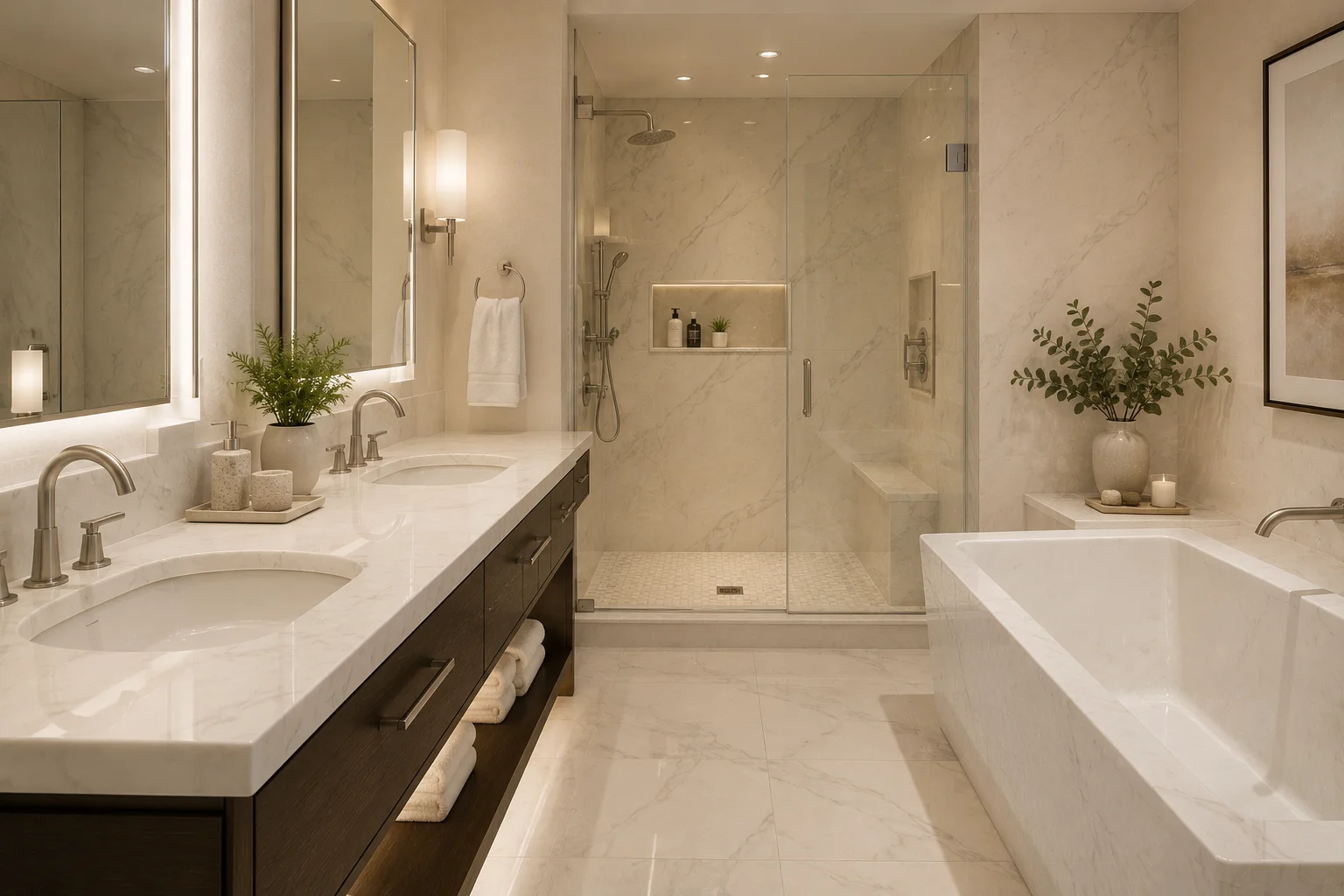
What is Cultured Marble?
The term gets thrown around loosely, but cultured marble is a specific engineered product with a defined composition. It's not veneer, it's not a laminate overlay but it's a cast composite material made to perform in wet, high-use environments - which is exactly why engineered marble bathroom surfaces have found such a strong foothold in the hospitality sector.
Cultured marble vanity tops, cultured marble shower walls, and associated bath products are manufactured to precise specifications, which means dimensional consistency across large-volume orders. That kind of predictability matters when you're outfitting a hundred bathrooms that all need to look the same on opening day.
How Cultured Marble is Manufactured
The production process starts with a mold - usually made from fiberglass - that defines the final shape of the piece. A gel coat is applied first, creating the visible surface layer. This gel coat layer is where the color, veining, and texture live. Once the gel coat cures, the backing mixture - a blend of marble dust (calcium carbonate), liquid polyester resin, and pigment - is poured into the mold and allowed to cure under controlled conditions.
After demolding, the surface is polished or left with a matte finish depending on specification. The result is a single-piece, non-porous product that integrates the surface and the structure into one unit. There are no subsurface voids, no seams between the sink basin and the countertop in an integrated design, and no porous substrate for moisture to work into over time.
Key Components of Cultured Marble
Three materials do most of the work. Marble dust gives the product its density and its stone-like aesthetic. Polyester resin binds everything together and provides the non-porous character that makes the material hygienic and moisture-resistant. Pigments - dispersed throughout the gel coat - create the color and veining patterns that give cultured marble its visual range, from clean whites to deep charcoals with complex movement.
Some manufacturers also incorporate additives to improve impact resistance or UV stability, which is relevant for properties with high natural-light exposure in their bathroom designs. The gel coat itself typically runs between 60 and 90 mils thick - thin enough to be workable, thick enough to be durable under commercial use.
Benefits of Cultured Marble for Hospitality Bathrooms
The case for commercial cultured marble in hospitality settings isn't built on one feature - it's a combination of performance characteristics that work together. No single benefit would be enough to justify the specification. The cumulative picture is where the value becomes clear.
Durability for High-Traffic Hotel Bathrooms
Hotel bathrooms are used hard. Guests check in tired, they're not always careful, and turnover rates mean these spaces see more use in a year than most residential bathrooms see in a decade. The gel coat surface on cultured marble is resistant to the kinds of daily impact - cosmetic containers dropped on countertops, luggage scuffs, cleaning product contact - that would mark or dull softer materials. A properly maintained cultured marble vanity top can hold up through years of high-occupancy cycles without losing its surface integrity.
Seamless Installation for Shower Walls
Grout lines are maintenance liabilities. They discolor, they harbor mildew, and in a commercial bathroom environment where cleaning is often done quickly and with strong chemicals, they deteriorate faster than most people expect. Cultured marble shower walls eliminate the majority of those joints. A standard three-piece or five-piece surround system creates a bathroom that's nearly grout-free, which is a real operational advantage when you're managing housekeeping across dozens or hundreds of rooms.
Moisture Resistance
The non-porous nature of the gel coat surface means water doesn't work into the material the way it would with natural stone or ceramic tile with porous grout. This is significant in a shower environment, but it also matters at the vanity - splash zones around sinks, pooling water near faucets, and the general humidity that accumulates in enclosed bathrooms are all managed more effectively with a non-porous surface. There's no sealing regimen required, no annual treatments, no monitoring for water infiltration.
Easy Cleaning and Maintenance
Housekeeping speed matters at scale. A surface that can be wiped down with standard cleaning products in under two minutes is worth more operationally than one that requires special chemicals or careful technique. Cultured marble fits that profile - it responds well to mild cleaners, doesn't require abrasives, and doesn't show water spots the way some natural stone finishes do. For engineering and maintenance staff dealing with occasional surface repair, minor scratches in the gel coat can often be buffed out rather than requiring full replacement.
Cost-Effective Alternative to Natural Stone
Natural marble, quartzite, and premium granite are beautiful. They're also expensive to source, expensive to fabricate, and expensive to maintain. For a boutique property with ten suites where the bathroom is a core design feature, that calculus might work out. For a 200-room select-service hotel where the bathroom needs to look clean, current, and consistent, cultured marble delivers comparable aesthetics at a fraction of the installed cost. The savings compound when you're looking at a full renovation program across multiple properties.
Applications of Cultured Marble in Hotel Bathrooms
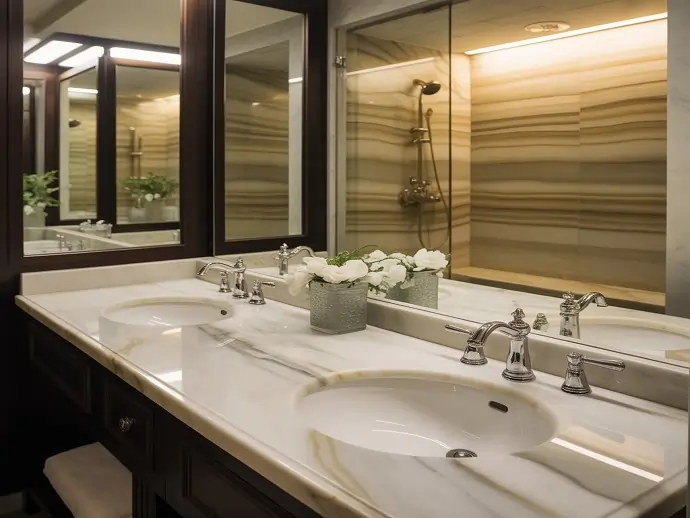
The range of products available in cultured marble has expanded considerably over the past two decades. What started as primarily a vanity top solution now covers nearly every horizontal and vertical surface in a hotel bathroom. Understanding the full range of applications helps procurement teams and designers specify cultured marble where it performs best.
Cultured Marble Vanity Tops for Hotels
This is where most hotel specifications start. Cultured marble vanity tops are available in virtually any width, with single or double bowl configurations, and with integrated sink basins that eliminate the seam between basin and deck. For renovation projects where existing cabinetry is being retained, cultured marble tops can be fabricated to match existing footprints precisely. Lead times are generally shorter than natural stone because the manufacturing process doesn't depend on quarry availability.
Selecting the right vanity surface affects maintenance costs, guest experience, and renovation timelines. See how hotels choose cultured marble vanity tops for durability and performance
Cultured Marble Shower Pans
Cultured marble shower pans offer a one-piece shower floor that installs faster than tile, drains predictably, and holds up against the daily punishment of commercial use. Pre-sloped designs eliminate on-site work that can introduce inconsistency, and the non-porous surface prevents the staining and discoloration that tile grout is prone to over time. For full bathroom renovations, pairing a cultured marble shower pan with matching wall panels creates a visually cohesive enclosure that's also easier to clean.A well-specified Commercial Cultured Marble Shower Pans & Surrounds system eliminates nearly all grout joints in the enclosure, which directly reduces housekeeping time and long-term maintenance costs across a high-occupancy property.
Cultured Marble Shower Walls & Surrounds
Cultured marble shower surrounds are typically installed as three-panel or five-panel systems. The panels interlock with minimal visible seaming and can be ordered in sizes that cover full wall heights without horizontal joints. In terms of installation speed, a pre-fabricated cultured marble surround system beats site-set tile by a significant margin - an important consideration when renovation timelines are tied to room inventory and revenue. The aesthetic range has also grown; current offerings include veined patterns that credibly replicate the look of slabs cut from natural stone.
Cultured Marble Bathroom Countertops
Beyond the vanity, cultured marble finds use at ledges, toilet tank tops, and accessory surfaces throughout the bathroom. Consistency matters here - using the same material family across the entire bathroom creates a coherent design without requiring the careful color-matching that mixing materials demands.
Integrated Sink & Vanity Systems
One of the cleaner applications for hospitality use is the fully integrated sink and vanity top - a single cast piece where the bowl is formed as part of the countertop with no seam at the basin perimeter. From a sanitation standpoint, this is about as low-risk as a bathroom surface gets. There's nowhere for biofilm to establish along a caulk line, no joint to reapply over time. For properties focused on health and safety protocol - which is nearly all of them at this point - the integrated design removes a maintenance variable that tile-and-undermount configurations introduce.
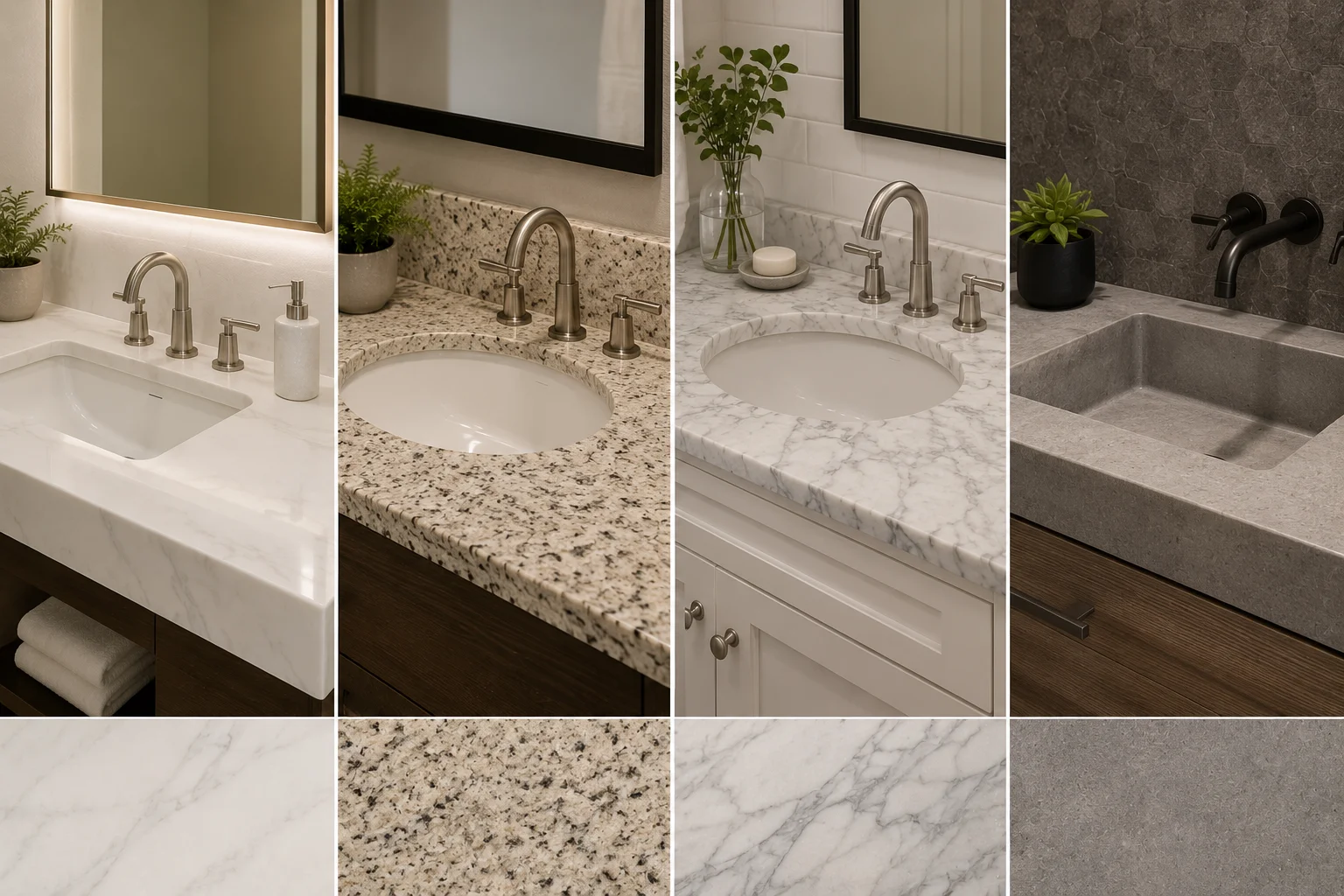
Cultured Marble vs Other Bathroom Materials
Cultured Marble vs Quartz
Engineered quartz is harder and more scratch-resistant than cultured marble, and it's available in a wider range of current design aesthetics. The trade-off is cost - quartz countertops run meaningfully higher per unit, and for hospitality projects at volume, that gap adds up. Quartz also doesn't lend itself to integrated sink fabrication the way cultured marble does, which means more components and more seams in the final installation.
Cultured Marble vs Granite
Natural granite is porous, which creates ongoing maintenance obligations in a hotel context. It requires periodic sealing, it can stain if cleaning products sit on the surface, and because it's cut from natural slabs, achieving consistent appearance across a large room count is genuinely difficult. Cultured marble wins on consistency, maintenance simplicity, and cost - though granite still holds a design edge in luxury applications where material provenance is part of the guest narrative.
Cultured Marble vs Solid Surface
Solid surface materials like Corian offer similar non-porous performance and are also thermoformable, which allows for more complex shapes. Where cultured marble tends to win is on cost and on the authentic stone aesthetic - solid surface reads as more plastic to the eye, which can work against it in mid-scale and upscale hotel contexts. Cultured marble's gel coat can be polished to a gloss level that reads convincingly as stone, which is harder to achieve with solid surface without more finishing work.
For hotel renovation teams evaluating different materials, it’s helpful to understand how cultured marble compares to alternatives like quartz and granite. Our full breakdown of cultured marble vs quartz vs granite for hotel bathrooms covers the pros, costs, and practical considerations for hospitality projects.
Custom Cultured Marble Solutions for Hotels
One of the more useful aspects of cultured marble as a hospitality material is how well it accommodates custom specifications. Unlike natural stone, which requires working within the constraints of what a quarry produces, cultured marble is manufactured to order. That means the designer or procurement team drives the specification rather than adapting to material limitations.
Custom Sizes for Hotel Bathrooms
Hotel bathrooms are rarely built to residential standard dimensions. Older properties especially have bathrooms with unusual footprints, offset plumbing, and non-standard alcove widths. Custom cultured marble vanity tops can be fabricated to match those dimensions with millimeter precision, which is meaningfully easier than trying to cut down a slab or work around a standard-size top that doesn't quite fit.
ADA-Compliant Vanity Designs
ADA compliance has become a baseline requirement for any commercial bathroom renovation, not just in designated accessible rooms. Custom cultured marble vanity tops can be specified at the required 34-inch maximum height, with knee clearance designs that accommodate the integrated bowl position required for compliant installations. Getting this right from the factory eliminates field modifications that add time and cost to the installation.
Custom Colors and Finishes
The color palette available through commercial cultured marble manufacturers covers a broad range - from bright whites and creams through grays and taupes into darker charcoals and black. Veining patterns can be adjusted to match a property's design language, and finishes can be specified as high-gloss, semi-gloss, or matte. For renovation projects on branded hotel properties, the ability to match finishes across a room count without visible variation is a practical advantage that's easy to underestimate until you've dealt with the alternative.
Integrated Sink Designs
Integrated sink designs can be customized not just in basin position but in depth, bowl profile, and overflow configuration. For hospitality applications, shallow bowls with wide decks are often preferable - they feel generous without sacrificing the counter space that hotel guests use for toiletries and personal items. Custom commercial bathroom vanity tops allow procurement teams to dial in those proportions to match the property's bathroom concept rather than defaulting to whatever standard size is in a catalog.
Cultured Marble Installation for Hospitality Projects
For renovation managers, the installation side of cultured marble is often where the material proves its value beyond aesthetics. Commercial bathroom installation of cultured marble is faster, less disruptive, and more predictable than tile-based alternatives.
Pre-Fabricated Panels
Wall panels and surround systems arrive at the job site pre-cut to specification. There's no on-site tile cutting, no setting mortar drying time, no grouting phase. The panels are secured with adhesive and sealed at corner joints - a process that a skilled crew can complete in a fraction of the time a tile installation requires. For hotel renovation projects where bathrooms are being turned room by room, that speed differential translates directly into how quickly revenue-generating inventory comes back online.
Fast Installation Benefits
A complete cultured marble bathroom - vanity top, shower pan, shower surround - can typically be installed in a single day per room with a properly organized crew. Tile installations for the same scope regularly run two to three days minimum, often more when you account for curing time before grouting and the grouting cure before the room can be used. Over a 50-room renovation program, that difference in installation speed is a meaningful financial variable.
Reduced Construction Downtime
Beyond individual room turn times, the pre-fabricated nature of cultured marble components reduces the on-site complexity that drives schedule overruns. Less cutting means less dust and debris. Fewer wet trades means less coordination overhead. For properties that remain partially operational during renovation - which is most of them - the reduced disruption to adjacent occupied rooms is a hospitality operations benefit that doesn't always make it onto the specification sheet but absolutely influences the guest experience during construction phases.
Discover Our Cultured Marble Products
Explore high-quality cultured marble solutions designed for hospitality, commercial, and multi-unit projects. Built for durability, consistency, and large-scale installations.
Maintenance Guide for Cultured Marble in Hotels
Cultured marble's maintenance profile is one of its stronger selling points for hotel operations, but getting the best long-term performance out of the material requires some attention to how it's treated day to day.
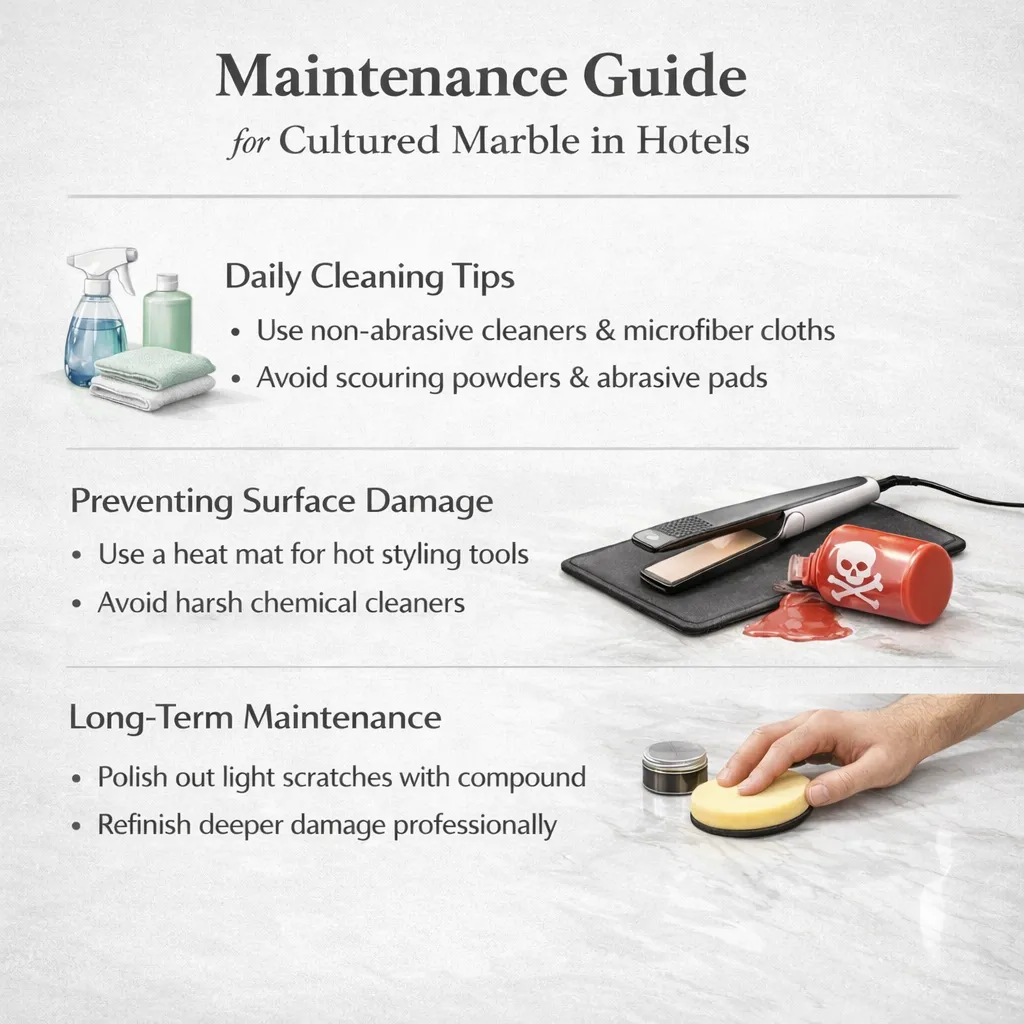
Daily Cleaning Tips
Standard non-abrasive bathroom cleaners work well on cultured marble surfaces. Spray cleaners, mild liquid detergents, and soft microfiber cloths are the right tools. Avoid anything with grit - scouring powders, abrasive pads - as these will dull the gel coat finish over time. For housekeeping programs, it's worth including a brief line in the SOP specifying non-abrasive products only, since the default cleaning supplies used by many housekeeping teams include scrubbing agents that can degrade the surface finish over months of daily use.
Preventing Surface Damage
Heat is the main chemical vulnerability. Setting curling irons, straighteners, or hot styling tools directly on a cultured marble vanity top can cause discoloration or cracking in the gel coat. Small placards or a line in the in-room guest information directing guests to use a heat mat can prevent what is otherwise a recurring maintenance call. Similarly, harsh chemical drain cleaners spilled on the surface - which happens more than you'd expect - can damage the finish if left in contact. Prompt cleanup prevents most of these issues.
Long-Term Maintenance
One of the practical advantages of cultured marble over natural stone is that it never requires sealing. There's no periodic professional maintenance program to schedule. For minor surface scuffs and light scratches, the gel coat can be polished out using automotive-grade compound applied with a soft cloth. More significant surface damage - deep scratches, chips, or heat discoloration - can often be addressed by a professional refinishing service rather than requiring full replacement of the piece. This keeps long-term maintenance costs contained in a way that natural stone and some tile installations don't allow.
Choosing the Right Cultured Marble Supplier in USA
The quality of a cultured marble installation is only as good as the quality of the products coming off the manufacturer's production floor. With a number of cultured marble suppliers USA operating at varying scales and quality levels, the selection process deserves real attention.
What to Look for in a Supplier
Start with ANSI compliance - products meeting ANSI Z124 standards for plastic plumbing fixtures have been tested against defined performance benchmarks that matter for commercial use. Beyond certification, look at gel coat thickness specifications, the resin-to-filler ratios disclosed in product technical data sheets, and the manufacturer's warranty terms. A supplier confident in their product's durability will back it with a warranty that reflects commercial use conditions, not just residential ones.
Experience in Hospitality Projects
There's a meaningful difference between a cultured marble manufacturer USA that primarily serves residential contractors and one with a track record in hospitality. Hotel projects involve large order volumes, tight tolerances, coordinated delivery schedules, and sometimes unusual dimension requirements. A supplier that hasn't navigated that environment before will show it - in communication breakdowns, in lead time surprises, in products that don't match the submitted samples when the full order arrives. Ask for references from comparable hotel projects and actually call them.
Custom Manufacturing Capabilities
For any hospitality project that moves beyond standard catalog configurations - unusual room dimensions, ADA-compliant designs, property-specific color matching - the supplier needs genuine custom manufacturing capability, not just the ability to cut a standard slab to a different size. Evaluate whether the manufacturer has its own molding program or is working from a limited set of stock molds, and whether their color matching process involves in-house pigment work or reliance on pre-made compounds.
Logistics & Delivery for Hotel Projects
A 200-room hotel renovation has a delivery coordination challenge built into it. Products need to arrive on a schedule that aligns with the construction sequence, in quantities that match the room-by-room installation program, and packaged in a way that allows for site storage without damage. Discuss these logistics expectations explicitly with any prospective supplier before awarding work, not after. Freight damage rates, lead time consistency, and the supplier's ability to accommodate phased deliveries are all factors that a strong hospitality supplier will have established answers for.
Why Hotels Choose Cultured Marble for Bathroom Renovations
The reasons hotels come back to cultured marble project after project aren't complicated. It's a material that does what it promises, at a price point that works for commercial construction budgets, with an installation profile that fits the compressed timelines renovation managers are always working against. It looks right in a hotel bathroom - not spectacular, not cheap, but clean and consistent and quality - which is exactly the register most hotel bathrooms are trying to hit.
Beyond the individual property calculus, branded hotel groups and management companies have come to value the specification consistency cultured marble allows. When you're maintaining a brand standard across 50 properties in a portfolio renovation cycle, the ability to specify the same product family, the same color, the same finish, and have it arrive looking identical whether it's manufactured for a property in Texas or Ohio is not a small thing. Natural stone doesn't offer that. Tile can come close but rarely delivers it perfectly. Cultured marble, from a consistent supplier with a stable production program, does.
There's also the housekeeping reality, which hotel operators are often better positioned to appreciate than architects or designers. A surface that cleans fast, doesn't show water spots under bad lighting, and doesn't develop the kind of grout discoloration that makes an otherwise adequate bathroom look neglected after two years of use - that surface pays for itself over the life of a renovation. Cultured marble is that surface.
Conclusion
Cultured marble for hospitality bathrooms has earned its position in the commercial construction market through consistent performance, not marketing. The material works well because it was designed for the conditions hotel bathrooms actually present - not idealized residential use, but daily commercial cycles in spaces that get cleaned fast, used hard, and expected to look presentable for years without major investment.
For hotel owners and procurement teams evaluating their next renovation program, the specification decision around bathroom surfaces is worth getting right the first time. Cultured marble offers a path to bathrooms that photograph well, operate efficiently, and hold up over the long haul - at a cost that makes the math work whether you're doing one property or twenty.
If you're sourcing cultured marble products for a hospitality project, Sarahospitalityusa.com offers a range of commercial-grade cultured marble vanity tops, shower systems, and custom fabrication solutions designed specifically for hotel and hospitality applications. Contact our team to discuss your project requirements.
- SOFT SEATING
- BATHROOM VANITY
- FIXTURE EQUIPMENT
- Hospitality Casegoods
- Hospitality outdoor furniture
- Senior Living Furniture
- Hotel reception desk
- High end contract furniture
- Premium Hotel Bedroom Furniture
- Custom commercial furniture
- Hospitality Furniture Manufacturers in Canada
- Leading Hotel Furniture Manufacturers in Canada
- Casegood manufacture canada
- Cultured Marble
- SPC Flooring
- Boutique Hotel Furniture
CATEGORIES




FREQUENTLY ASKED QUESTIONS