
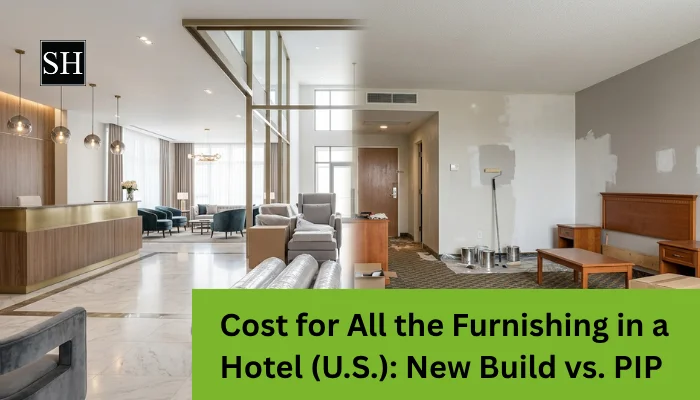
Total hotel furnishing costs depend on brand tier, project scope, and whether you're building new or completing a property improvement plan. Economy and select service properties typically run $4,000 to $7,000 per room for guest room FF&E alone in 2026, while midscale brands land closer to $8,000 to $15,000. Upscale properties generally fall between $15,000 and $25,000 per room, and luxury hotels regularly exceed $35,000 with many climbing past $55,000 when custom millwork and public area furnishings enter the picture. These figures cover furniture, fixtures, and equipment but usually don't include freight, duties, or installation, which add another 18 to 22 percent on top of the base number.
Why Are U.S. Hotel Owners Renovating and Furnishing Hotels in 2026?
Several converging pressures are pushing American hotel owners to invest heavily in furnishing programs this year, and the financial stakes keep climbing for those who delay necessary upgrades.
- Brand mandated PIPs now cost roughly 30 percent more than they did before the pandemic, putting serious budget pressure on owners operating aging properties nationwide.
- A $48 billion wave of hotel CMBS loan maturities hitting through 2026 forces owners to demonstrate property value through updated guest room conditions.
- Post pandemic guest expectations for cleaner and more modern accommodations have raised the baseline quality standard for hotel furniture across every market segment.
- Franchise agreements typically require complete FF&E refreshes every seven to fifteen years, and many properties built during the last construction boom are now due.
Delaying necessary furniture investments often leads to declining guest scores, reduced brand compliance, and ultimately lower property valuations during refinancing or sale.
What Does Furnishing a Hotel Include? FF&E vs. OS&E Explained
Understanding the distinction between FF&E and OS&E prevents costly surprises when finalizing your room furnishing budget for any new build or renovation project. FF&E covers furniture, fixtures, and equipment, which means items like casegoods, seating, lighting, mattresses, drapery hardware, and bathroom mirrors that define the guest experience directly.
- FF&E includes everything a guest physically interacts with, from the desk chair and nightstand to the TV mount and reading lamp beside the bed.
- OS&E covers operating supplies and equipment, including linens, towels, glassware, hangers, irons, hair dryers, and waste bins used during daily operations.
- FF&E typically represents the larger capital expenditure, while OS&E functions as a recurring operational line item within the property's annual budget.
- Brand standards specify both categories separately, and manufacturers usually quote FF&E and OS&E as distinct packages with entirely different production lead times.
Confusing these two categories during procurement regularly leaves owners short on budget when the full scope of furnishing requirements becomes clear later.
Hotel FF&E Cost Per Room by U.S. Brand Tier (2026)
Per room pricing varies dramatically based on brand positioning, design complexity, and whether public area furnishings are included in the project scope. The table below reflects 2026 vendor and consultant estimates for guest room FF&E packages across the major brand tiers.
|
Brand Tier |
Guest Room FF&E Per Room |
Total FF&E Including Public Areas |
|
Economy / Select Service |
$4,000 to $7,000 |
$6,000 to $12,000 |
|
Midscale |
$8,000 to $15,000 |
$14,000 to $25,000 |
|
Upscale / Full Service |
$15,000 to $25,000 |
$25,000 to $45,000 |
|
Luxury / Boutique |
$35,000 to $55,000+ |
$60,000 to $100,000+ |
These ranges assume domestically sourced or tariff adjusted pricing, and they exclude freight, installation, and contingency reserves that typically add 20 to 30 percent to the base furniture cost.
What Furniture Goes Into a Typical U.S. Hotel King Room?
A standard king room package across most midscale and upscale brands includes a dresser, nightstand, writing desk with chair, luggage bench, headboard wall panel, media console, and a wardrobe or closet system. Bedding components, lighting fixtures, window treatments, and decorative accessories round out the complete room package, though brands categorize some items under soft goods rather than casegoods in their specification documents.
Why Do Extended Stay Hotels Cost More to Furnish Per Room?
Extended stay properties require additional furnishing categories that traditional hotels don't include, such as full kitchenettes with cabinetry, countertops, appliances, and dining furniture sets. These extra components push the per room FF&E budget roughly 25 to 40 percent higher than a comparably positioned traditional brand, because each room essentially functions as a small apartment requiring both hospitality grade and residential grade furnishing elements.
New Hotel FF&E Budget vs. PIP Furniture Cost vs. Brand Conversion
The financial gap between building new, renovating under a PIP, and converting to a different flag determines which path delivers the strongest return for owners facing mandatory property updates this cycle.
- New construction runs highest because every room and public area starts from zero, with furniture allocation typically consuming 8 to 12 percent of total development cost.
- Renovation spending for midmarket brands currently ranges from $10,000 to $30,000 per room depending on scope, and comprehensive PIPs can reach $35,000 to $40,000 per key.
- Brand conversions sometimes reduce furniture spending because the incoming flag may accept partial reuse of compliant items that already meet its updated design standards.
Owners should always request a detailed PIP scope letter from the brand before finalizing any budget projections for their planned renovation or conversion project.
Which U.S. Compliance Rules Affect Hotel Furniture Cost? (TSCA, ADA, Fire Codes)
Federal and state regulations add measurable cost to every hotel furniture program, and failing to account for compliance during procurement creates expensive replacement obligations after delivery.
- TSCA Title VI requires all composite wood products in hotel furniture to meet EPA formaldehyde emission limits, meaning panels must carry third party certification and labeled compliance documentation.
- California TB 117 and similar state fire codes mandate smolder resistance testing for upholstered seating and mattresses, adding roughly 15 to 20 percent to the unit cost of treated items.
- ADA accessibility standards dictate furniture placement, clearances, and fixture heights in designated accessible guest rooms, affecting both product selection and professional installation requirements.
- Local fire marshals may require additional flame resistance certifications beyond state minimums depending on the specific municipality where the property operates.
Non compliant furniture that fails a brand or code inspection must be replaced entirely at the owner's expense, making upfront compliance verification absolutely essential.
What Isn't in a Hotel Furniture Quote? Freight, Duties and Installation in the U.S.
Most manufacturer quotes cover only the FOB factory price of finished goods, which means several significant cost categories show up as separate line items that owners must budget for independently.
- Domestic freight from factory to property typically adds 8 to 12 percent of the total furniture order value depending on shipping distance and volume.
- Import duties on furniture from China currently run approximately 37 percent effective rate, while Vietnamese sourced goods face roughly 12.5 percent under current trade terms.
- Professional installation including receiving, unpacking, assembly, placement, and debris removal adds another 8 to 10 percent on top of the landed furniture cost.
- A standard 5 to 10 percent contingency reserve covers damage during transit, product defects discovered at installation, and last minute brand standard revisions.
Failing to account for these additional categories means owners regularly face 25 to 35 percent budget overruns on furnishing programs that looked affordable at the initial quote stage.
How Do 2026 U.S. Tariffs Affect Imported Hotel Furniture?
Section 232 tariffs currently impose a flat 25 percent duty on upholstered wood furniture and cabinetry entering the United States from any country, and this rate increases to 30 percent starting January 1, 2027. Hotels importing casegoods from China face an additional Section 301 layer that pushes effective rates near 37 percent, while Vietnamese sources sit closer to 12.5 percent after recent IEEPA duty removals. Owners placing large import orders should strongly consider locking in pricing and shipping schedules before the 2027 rate increase takes effect to protect their budgets.
How Does Hotel Furniture Cost Per Room Vary Across the USA?
Hotel furniture cost per room USA varies significantly based on local labor rates, freight distances from manufacturing centers, and jurisdiction specific compliance requirements that differ from one state to another.
- Properties in the Southeast and Midwest benefit from lower installation labor costs and close proximity to domestic furniture producers concentrated in North Carolina and Mississippi.
- Coastal markets like New York, San Francisco, and Miami face higher freight expenses, stricter local fire codes, and elevated installation labor rates across the board.
- Properties operating in states with California level flammability requirements or stricter formaldehyde regulations face compliance cost premiums on upholstered goods and composite wood products.
Understanding these regional variables helps owners build more accurate project budgets rather than relying on national averages that may not reflect their specific market.
What Happens When Hotel Furniture Fails Brand Inspection?
Brand inspectors evaluate furniture against detailed design standard documents during pre opening and post renovation quality assurance visits, and the consequences of failure go well beyond surface aesthetics.
- Failing an inspection triggers a mandatory correction period, typically 30 to 90 days, during which the owner must replace or refinish all non compliant items entirely at their own cost.
- Repeated inspection failures can result in franchise agreement termination, removing the brand's reservation system and loyalty program from the property completely.
- Some brands withhold the property's opening date or marketing support until every single furniture item passes their inspection criteria, which delays revenue generation significantly.
Working with manufacturers who already understand specific brand design standards reduces inspection risk substantially and prevents costly last minute furniture replacements across the property.
Example: Cost for All the Furnishing in a 100 Key Hotel in Atlanta
A midscale select service hotel opening in Atlanta during late 2026 provides a practical look at real world furnishing costs for a complete ground up project. Guest room FF&E at $12,000 per room totals $1,200,000 for all 100 keys, while public area furnishings covering the lobby, breakfast room, fitness center, and meeting space add approximately $180,000 to the total. Freight and installation at 20 percent contribute another $276,000, and a 7 percent contingency reserve adds roughly $115,920 as a safety buffer. The total furnishing budget lands at approximately $1,771,920, which works out to roughly $17,720 per key when all logistics and reserves are fully included. This figure excludes OS&E, technology packages, and any tariff exposure on imported furniture components.
How to Lower Hotel Renovation Furniture Cost Without Failing Inspection
Smart procurement strategies can meaningfully reduce renovation spending on furniture without putting brand compliance at risk, and the biggest savings typically come from timing and sourcing decisions rather than quality compromises.
- Ordering during manufacturer off peak production windows, typically January through March, can yield 8 to 15 percent discounts on casegoods and upholstered seating orders.
- Consolidating furniture orders across multiple properties within the same ownership group creates volume pricing leverage that single property orders simply can't access.
- Requesting value engineering from manufacturers on non visible components, such as drawer box materials or internal frame construction, reduces cost without affecting the room's visual presentation.
- Reusing compliant items that pass the brand's inspection during the PIP assessment eliminates unnecessary replacement spending on furniture that still meets current standards.
Partnering with experienced manufacturers who understand brand standard requirements ensures that cost reduction decisions don't trigger inspection failures further along.
When Should U.S. Hotel Owners Order Furniture for a New Build or PIP?
Timing furniture procurement correctly prevents both costly delays and missed savings opportunities for owners planning their construction or PIP renovation in the current market environment. Domestic producers typically require 16 to 24 weeks of manufacturing lead time, while imported goods need 20 to 30 weeks including ocean freight and customs clearance processing. Locking in orders before January 2027 avoids the scheduled Section 232 tariff increase from 25 to 30 percent on upholstered wood furniture, which could add thousands per room to any imported order. Owners completing PIPs should carefully align their furniture order timeline with brand PIP scope approval to avoid purchasing items that don't match the final approved design standards.
Why U.S. Hotel Owners Choose Sara Hospitality for Brand Approved Furniture
Sara Hospitality manufactures brand compliant hotel furniture for major flags including Marriott, Hilton, IHG, and Wyndham, delivering consistent quality across new builds, PIP renovations, and brand conversions throughout the country. Their in-house design team works directly from each brand's current design standard documentation, eliminating the costly back and forth that delays production timelines when manufacturers aren't familiar with specific flag requirements. Sara Hospitality handles freight coordination and installation logistics through established regional partners, giving owners a single point of accountability from initial quote through final brand inspection approval at every property.