
Think about the last time you watched a parent or grandparent struggle to get up from a deep, soft sofa, pushing against the armrests, rocking forward two or three times and finally standing with a little help, and now imagine that same moment happening every single day, in every single apartment, across an entire community. Furniture that looks lovely in a showroom but is not supporting the person sitting on it is not just uncomfortable, it is also becoming a daily safety risk, and for operators/owners it is turning into a long-term cost through falls, complaints and early replacements.
This is exactly why choosing furniture for senior living is a very different job from furnishing a regular home or even a standard hotel. The pieces have to be supportive, safe, easy to clean, tough enough for heavy commercial use and still warm enough that residents are feeling at home and not like they are living in a care facility. Operators, interior designers, procurement managers and families furnishing a senior apartment are all facing the same challenge, and getting it right from the beginning is saving a lot of time, money and worry later.
In this guide, we are walking through what to look for, the seven essential pieces every apartment needs, how to judge durability and quality, what the pricing is looking like in the United States and how to choose a supplier you can trust, so let’s take a look.
What Is the Best Furniture for Senior Living?
But what exactly is the best furniture for senior living? Well, the short answer is furniture that is supporting the resident’s body, protecting their safety and standing up to the demands of a busy community, all while looking residential and welcoming. The best furniture for senior living is generally having these qualities:
- Seat heights that are making it easy to sit down and stand up, usually in the range of 18 to 20 inches.
- Firm, supportive cushions with sturdy armrests that residents can push against.
- Stable frames with wide bases that are not tipping or wobbling.
- Rounded corners and smooth edges to reduce injuries from bumps and falls.
- Surfaces and fabrics that are stain resistant and easy to disinfect.
- Enough clear space around each piece for walkers, canes and wheelchairs to pass through.
- Commercial grade construction that is lasting through years of daily use.
This is where assisted living furniture is really different from regular furniture, because home furniture is designed for comfort and appearance alone, while commercial furniture for assisted living is built around safety, hygiene, durability and accessibility as well. And that is not all, the furniture is also playing a big role in how residents are feeling about their new home, since a space that feels familiar and dignified is helping them settle in faster and enjoy their daily routine more. With that in mind, let’s break down the seven pieces that matter most.
7 Essential Furniture Pieces for Senior Living Apartments
1. Comfortable and Supportive Chairs and Recliners
If there is one piece that a resident is using more than any other, it is their main chair, since it is where they are reading, watching television, having visitors and often resting through large parts of the day. A good chair for older adults should have a seat that is firm enough to prevent sinking, a high back for neck and shoulder support, and arms that are positioned so the resident can lower and lift themselves with their hands.
Lift chairs and power recliners are also becoming very popular in assisted living apartments, since they are gently raising the resident to a standing position, which is reducing strain on the knees and hips and lowering the chance of a fall. Wing chairs and high-back chairs with a slightly upright posture are another great option for residents who do not need a lift but still want good support. It is extremely crucial to avoid low, deep, overly soft seating, as it is looking cozy but is making standing up much harder, and this is something operators and families should be checking before buying any chair.
2. Beds and Functional Bedside Tables
A bed in a senior apartment is doing a lot more than just providing a place to sleep, since residents are getting in and out of it several times a day, and the height, firmness and edge support are all affecting how safely they are doing so. Look for bed frames with a mattress height that lets the resident sit with their feet flat on the floor, and adjustable beds are really worth considering for residents who need help with circulation, breathing or reading comfortably in bed.
Bedside tables should be sturdy, stable and at a height that is easy to reach from the bed, with a drawer for medications, glasses and personal items, and a shelf or open space for a lamp, water glass and phone. Rounded edges and a solid base are definitely important here, since residents are often using the bedside table to steady themselves when getting up in the middle of the night. This is also why lightweight, wobbly tables should be avoided, and why a well-chosen bedside table is playing a bigger safety role than most people are expecting.
3. Storage Furniture for Small Senior Apartments
Most assisted living apartments are compact, and residents are often moving from a much larger home, so smart storage is making the difference between a space that feels organized and calm and one that feels cluttered and stressful. Wardrobes, armoires and closet systems with easy-glide doors, pull-out shelves and lower hanging rails are helping residents reach their belongings without stretching or climbing.
Open shelving, low bookcases and wall-mounted units are also helping to free up valuable floor space, which is leaving more room for walkers and wheelchairs to move around freely. Storage that is placed between waist and shoulder height is generally the easiest to use, and keeping everyday items within that zone is reducing the need for bending, reaching and stepping on stools, all of which are leading to falls when they are done repeatedly.
4. Lightweight Dressers and Space-Saving Cabinets
Dressers are one of the most used pieces in a bedroom, and for senior living they should have smooth, full-extension drawers that are opening easily without a hard pull, along with large, easy-grip handles that are comfortable for residents with arthritis or limited hand strength. A dresser that is too tall is making it difficult to reach the top, so a lower profile with wider drawers is usually a much better choice.
Space-saving cabinets and slim chests of drawers are working very well in smaller apartments, as they are offering plenty of storage without taking over the room. Many operators are also choosing dressers with tip-over protection and anchoring hardware, which is an extremely crucial safety feature that is keeping both residents and staff protected, and it is definitely something to ask about when comparing options.
5. Multifunctional Tables and Compact Dining Furniture
In a smaller apartment every piece of furniture is being asked to do more than one job, so tables that are serving as a desk, a dining spot, a craft area and a place to welcome family are very valuable. Look for tables with sturdy bases and rounded corners, a height that is allowing a wheelchair to slide underneath, and a surface that is easy to wipe down after every meal.
For compact dining furniture, a small round table with two or four chairs is often the best fit, since the curved shape is making it easier to move around and there are no sharp corners to bump into. Dining chairs should have arms, firm seats and a stable frame, and wipeable upholstery is making cleanup far easier after spills. Drop-leaf and extendable tables are also a smart option, since they are giving residents the option to host a family meal and then fold the table away to bring back their open floor space.
6. Bathroom Storage and Accessible Furniture Solutions
Bathrooms are where a large number of falls are happening, so furniture and storage here need extra thought. Wall-mounted shelves, slim cabinets, recessed storage and over-the-toilet units are keeping essentials within reach without taking floor space, while shower chairs, benches and fold-down seats are giving residents a safe place to sit while bathing.
Anything that is placed in a bathroom should be made from moisture resistant materials such as sealed laminates, metal, plastic or treated wood, otherwise the furniture is swelling, warping and breaking down within a short time. Keeping floors clear, using non-slip surfaces and making sure all storage is easy to open with one hand are all small details that are adding up to a much safer, more dignified bathing routine for residents.
7. Lobby and Common-Area Furniture for Senior Communities
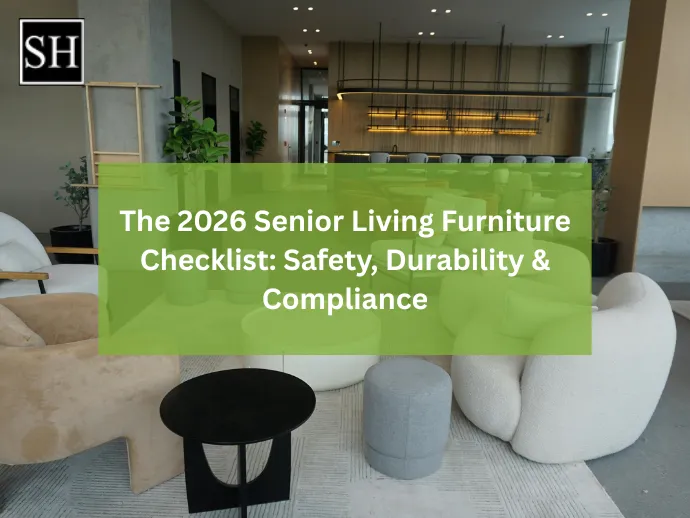
And that is not all, because the common areas are often where residents are spending a large part of their day, and they are also the first thing families and prospective residents are noticing on a tour. Lobby, lounge, dining room, library and activity room furniture needs to feel warm and inviting, while being tough enough for much heavier use than anything in a private apartment.
Good common-area furniture usually includes:
- Sofas and lounge chairs with firm seats and sturdy arms for easy standing.
- Small group seating that is encouraging conversation and social time.
- Dining chairs with wipeable upholstery and stable, wide-set legs.
- Tables with rounded edges and heights suited for wheelchair access.
- Bench seating near entrances and along corridors for resting spots.
- Activity tables that are adjusting easily for games, crafts and group classes.
This is why many operators are investing the most thoughtfully in their common areas, since they are definitely shaping the overall impression of the community, affecting resident happiness and even helping with move-in decisions when families are comparing multiple facilities. With the essentials covered, the next big question is how to pick furniture that is really lasting.
How to Choose Durable Furniture for Assisted Living Facilities
Durability is one of the most important parts of the buying decision, since furniture in assisted living is being used far more often, and far more heavily, than furniture in a home. Chairs are being sat on and pushed back several times a day, wheelchairs and walkers are bumping against legs and edges, and cleaning is happening constantly, so the furniture has to be built for all of it. Let’s go through the questions that operators and procurement managers are asking most often.
Which Furniture Materials Are Best for Assisted Living?
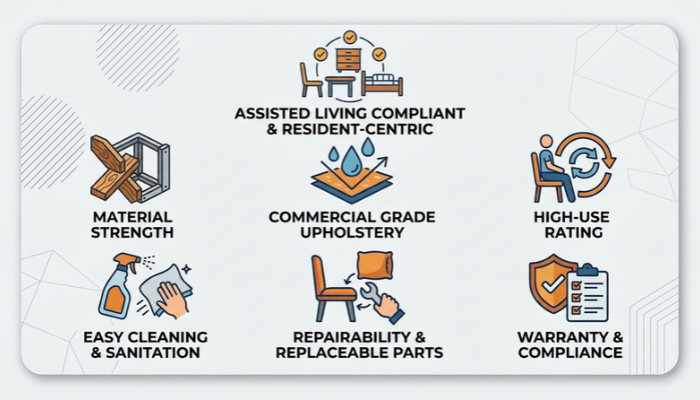
Solid hardwood and high quality engineered wood are generally the strongest choices for frames, as they are holding screws and joints well over many years of use. Metal frames, especially powder coated steel and aluminum, are also very durable and are working nicely for chairs and tables in dining and activity areas.
For tabletops and casegoods, high pressure laminate and thermofused laminate are great options, since they are resisting scratches, stains, heat and moisture while being easy to wipe down. It is best to avoid very soft woods, thin particle board and glass-heavy designs, as they are chipping, cracking or breaking much more easily under commercial use, and in a senior living setting a broken piece is also a safety hazard.
What Upholstery Is Suitable for High-Use Senior Living Spaces?
The upholstery is facing the toughest daily test, so it should be stain resistant, moisture resistant and easy to disinfect. Performance fabrics, solution-dyed fabrics and commercial grade vinyl or polyurethane are all popular choices, since they are handling spills, accidents and regular cleaning without wearing down or holding odors.
Look for fabrics that have a high rub count, which is the measure of how many cycles the fabric can take before showing wear, and for healthcare-style upholstery with a moisture barrier backing that is stopping liquids from reaching the foam. Patterns and mid-tone colors are also helping to hide minor marks, and warm, residential looking textures are making the space feel homelike and not clinical. It is also really crucial to check that the furniture meets the fire safety and flammability standards required by your state and local fire code, so please ask the supplier for the relevant test documentation before ordering.
How Can Facilities Choose Furniture That Is Easy to Clean?
Cleaning is happening every day in a senior living community, so furniture that is quick to clean is saving a lot of staff time and helping to keep the infection risks down. Smooth surfaces, sealed seams, minimal crevices and removable or replaceable cushion covers are making a big difference, since there are fewer places for dirt and bacteria to hide.
It is also worth confirming which cleaning products the finishes and fabrics can handle, as many facilities are using stronger disinfectants that can damage some materials over time. Choosing pieces that can be wiped with the same products your housekeeping team is already using is making daily work much simpler, and it is keeping the furniture looking good for far longer.
Why Are Repairability and Long-Term Durability Important?
Furniture that cannot be repaired is furniture that has to be replaced, and replacing pieces across a whole community is a big cost that is hitting the budget again and again. Furniture with replaceable cushions, removable legs, swappable fabric panels and available spare parts is allowing the maintenance team to fix small problems quickly, rather than taking an entire chair or table out of use.
This is also supporting the idea of lifecycle cost, which is looking at the total cost of owning a piece over its full lifetime, not just the price on the day it was bought. A slightly more expensive chair that is lasting ten years is usually far cheaper than a cheaper one that is needing replacement every three, and the reasons are not hard to see.
How Should Senior Living Operators Evaluate Furniture Quality?
When comparing options, it is best to look beyond the photos and ask the supplier for hard details, and operators are usually checking things like:
- Frame construction, joint type and the thickness of the materials used.
- Commercial testing standards, such as BIFMA, and weight capacity ratings.
- Foam density and cushion resilience for long-term seat comfort.
- Warranty length and what it is really covering.
- Availability of replacement parts and repair support.
- Fire safety documentation and compliance with local codes.
- Samples that can be touched, sat on and tested in person.
Taking a little extra time on this step is protecting the community from poor quality purchases, and it is giving the team confidence that the furniture will keep performing, resident after resident, year after year.
How Much Does Furniture for Senior Living Cost?
Pricing is varying widely depending on the materials, the level of customization, the quantity and whether the pieces are standard or made to order, so the figures below are only rough ranges for the United States and the actual quotes will differ from supplier to supplier.
|
Furniture Piece |
Typical Price Range (USD) |
|
Supportive chair or wing chair |
$400 – $1,200 |
|
Lift chair or power recliner |
$800 – $2,500 |
|
Bed frame (non-adjustable) |
$500 – $1,500 |
|
Bedside table |
$150 – $500 |
|
Dresser or chest of drawers |
$400 – $1,200 |
|
Compact dining table |
$300 – $900 |
|
Dining chair (with arms) |
$150 – $450 |
|
Lobby or lounge sofa |
$1,200 – $3,500 |
For a full assisted living apartment, many operators are budgeting somewhere in the range of $3,000 to $8,000 per unit, depending on the quality level and how many pieces are included, while common areas are usually needing a separate budget that is based on the size of the space and the number of residents it is serving. Buying in bulk, standardizing designs across apartments and working directly with a commercial furniture supplier are all helping to bring the cost per unit down, and it is wise to factor in delivery, installation and future replacement costs from the very start. This brings us to the final piece of the puzzle, choosing who to buy from.
How to Choose a Senior Living Furniture Supplier
The right supplier is making the whole process smoother, from the first design discussion until the last piece is placed in the room, so it is really worth being careful at this stage. A supplier who understands senior living is guiding you towards pieces that are meeting accessibility needs, fire codes and daily cleaning demands, while a general furniture seller may be missing these details completely.
Here is what to look for when comparing suppliers:
- Proven experience with senior living, assisted living and healthcare projects.
- A wide range of commercial grade products with customization options.
- Clear documentation on testing, safety standards and fire compliance.
- Reliable lead times and the ability to deliver in phases for new openings and renovations.
- Installation support and white glove delivery for large orders.
- Strong warranty terms and ongoing after-sales service.
- References or past projects that you can really see and ask about.
A good supplier is not just selling furniture, they are also becoming a long-term partner who is helping with design planning, budgeting, product selection and replacements as the community is growing. If you are planning a new community, a renovation or simply refreshing a few apartments, it is always a good idea to speak with a commercial furniture specialist early on, since this is saving time, avoiding costly mistakes and making sure the residents are getting furniture that is truly right for them.