
Hotel Franchise Renovation & Brand Conversion Guide (PIP Explained)
The email arrives from the corporate saying that your property has been issued a Property Improvement Plan (PIP) or perhaps you’re an independent owner weighing the power of aligning with a franchise flag. Either way, that moment is pivotal - a major investment and if handled correctly, a transformative opportunity.
Here’s the truth most owners quietly face, hotel renovation is exciting on paper but overwhelming in reality. Budgets spiral, Timelines slip, Guests leave reviews you never wanted. Without the right strategy and partners, these projects become expensive lessons instead of revenue-driving wins.
That’s exactly why this guide exists. Whether you’re navigating a Hotel Brand Conversion, responding to a PIP, or proactively upgrading your property, this is your comprehensive playbook - from initial strategy to grand re-opening. If you’re a hotel owner, general manager, asset manager, or part of a hospitality investment group, keep reading.
What is a Hotel Property Improvement Plan (PIP)? The Brand’s Blueprint
A Hotel Property Improvement Plan (PIP) is a non-negotiable list of renovations and upgrades your franchisor requires to bring your property in line with current brand standards - the brand’s way of protecting its reputation across every property flying its flag.
PIPs are most commonly triggered by three events: franchise renewal, change of ownership, or a brand-wide refresh cycle. When yours arrives, it will include a detailed scope of work, approved vendor lists, and hard deadlines.
Hotel Rebranding vs. Renovation: Choosing Your Strategic Path
These two terms get confused constantly, so let’s clarify them upfront.
- Hotel Renovation = updating and refreshing your property while staying within your existing brand family.
- Hotel Brand Conversion = changing your flag entirely - leaving one brand to join another (or going independent, and vice versa).
Renovation vs. Rebrand Comparison Table:
|
Factor |
Hotel Renovation |
Hotel Brand Conversion (Rebrand) |
|
Definition |
Updating your property within your existing brand family |
Switching flags entirely - joining a new brand or going independent |
|
Primary Trigger |
PIP issuance, franchise renewal, cosmetic refresh |
Brand no longer drives demand, ownership change, market repositioning |
|
Market Fit |
Current brand still aligns with local demand |
Competitive set has shifted or a stronger flag opportunity exists |
|
Typical Cost |
$8,000–$80,000+ per room depending on scale |
PIP costs + conversion fees + ongoing franchise fees |
|
Timeline |
3–12 months depending on scope |
Longer - brand application, assessment, PIP, inspection, then launch |
|
Disruption Level |
Moderate - can be phased around high-revenue periods |
High - full operational and brand identity transition |
|
ROI Driver |
Improved guest scores, brand compliance, asset preservation |
Access to loyalty programs, global reservations, and marketing scale |
|
Best For |
Properties with strong brand alignment needing a refresh |
Properties where repositioning is needed to compete or grow RevPAR |
|
Risk Level |
Lower - known brand standards and existing relationships |
Higher - new compliance obligations, upfront investment, guest re-education |
|
FF&E Requirement |
Partial to full replacement depending on PIP scope |
Typically full FF&E overhaul to meet new brand standards |
|
Franchise Fees Post-Project |
Existing fee structure continues |
New fee structure based on incoming brand agreement |
|
Long-Term Asset Value |
Maintained or incrementally improved |
Significant uplift if repositioned to a stronger brand tier |
Read the complete hotel rebranding vs renovation breakdown !
The Conversion Equation: Turning an Independent Hotel into a Franchise Powerhouse
Independent hotels have soul - but franchise flags bring scale. Joining a brand means immediate access to loyalty programs, global reservation systems and marketing muscle you can’t replicate alone. The tradeoff? Upfront PIP costs, ongoing franchise fees and brand compliance obligations.
The process moves in phases: brand application → property assessment → PIP issuance → renovation execution → brand inspection → launch. Skipping steps is a costly mistake.
Read more: Step-by-step guide to converting your independent hotel into a successful franchise brand
Hospitality Renovation Management: Team Setup, Scope Planning & Timeline Strategy
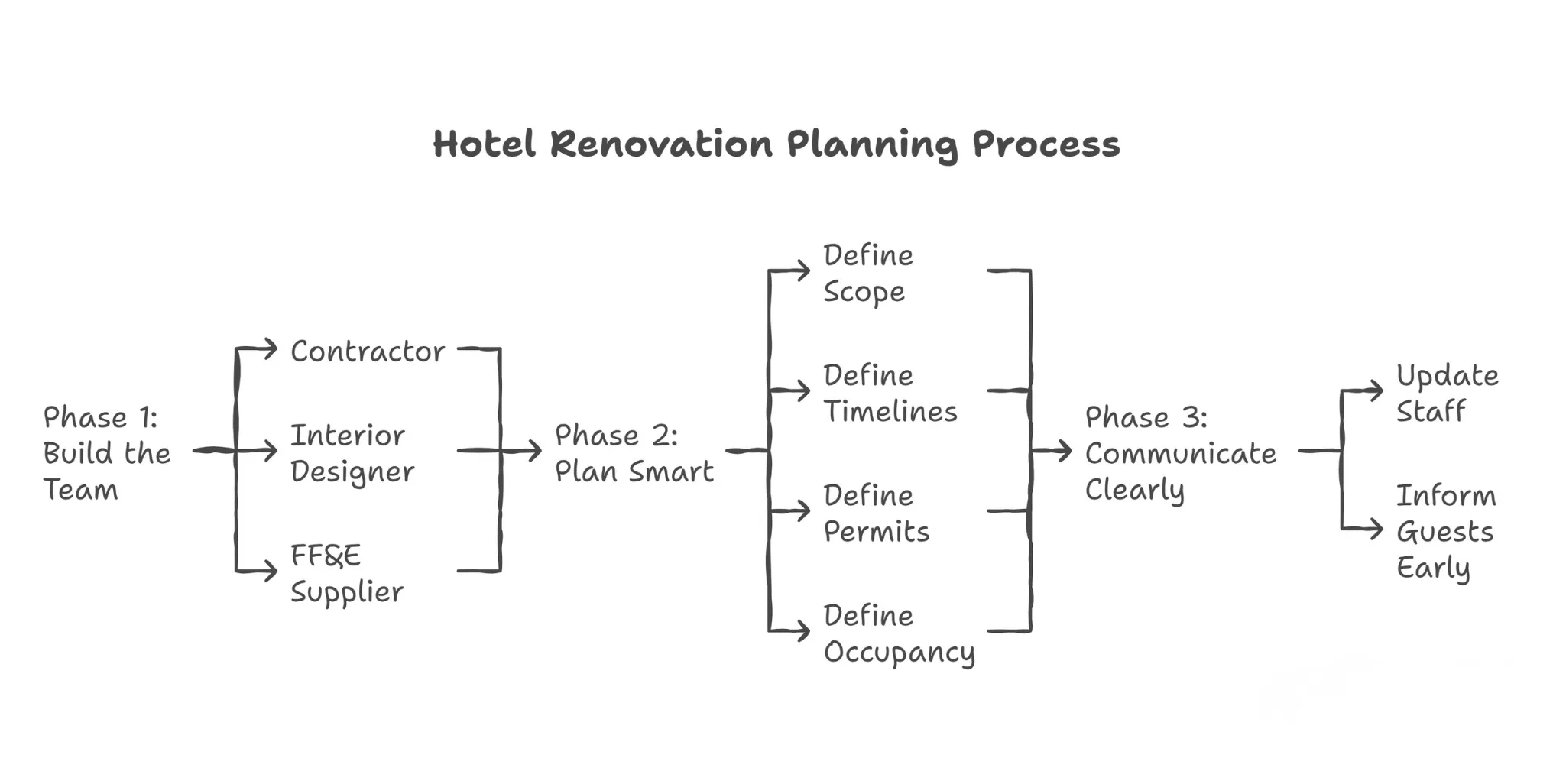
Strong Hospitality Renovation Management starts long before a single wall is touched. Here’s how to structure your approach:
- Phase 1 - Assemble Your Team, you need a qualified renovation contractor, a hospitality-focused interior designer and a proven Hotel FF&E supplier. These three need to work in sync from day one.
- Phase 2 - Define Scope & Build a Realistic Timeline. Account for FF&E lead times, permit approvals, and seasonal occupancy. Protecting your highest-revenue periods is non-negotiable.
- Phase 3 - Communicate Early and Often. Staff need operational clarity; guests need honest, proactive communication. Both will forgive inconveniences if they feel respected and informed.
Decoding the Hotel Renovation Cost Per Room
The budget is where ambition meets reality. Here are industry-average ranges to anchor your planning:
- Economy/Budget Hotels: $8,000–$15,000 per room
- Mid-Scale Hotels: $15,000–$35,000 per room
- Full-Service/Upscale: $40,000–$80,000+ per room
What moves the needle most? Hotel FF&E Renovation costs, construction complexity, soft goods, technology infrastructure and labor. Beyond your base budget, always - always - set aside a 10–15% contingency fund. Surprises in renovation aren’t a possibility; they’re a guarantee.
Transform Your Hotel Renovation
Need help planning your hotel renovation or sourcing FF&E? Talk to our expert team for a tailored project consultation.
Schedule Your Consultation
The Heart of Your Renovation: Hotel FF&E Procurement
Hotel FF&E or Furniture, Fixtures & Equipment is the physical heartbeat of your guest experience. It’s what guests touch, sit on, sleep in, and remember (or complain about).
When evaluating FF&E for a Hotel Franchise Renovation, one term matters above everything else: contract-grade hospitality furniture. Unlike residential furniture, contract-grade pieces are engineered for commercial punishment - high-cycle testing, double-rub fabric durability ratings, and finishes built to survive years of daily guest use. Cutting corners here is a false economy that costs far more in replacements and reputation.
Planning a PIP or renovation? Explore our contract-grade hotel furniture collections designed for brand compliance and durability.
Hotel Renovation vs Rebranding
Not every property faces the same decision and choosing between a renovation and a full brand conversion can define the next decade of your asset's performance. The right path depends on your market position, competitive set and long-term investment goals. Use the framework below to evaluate where your property stands and which strategic route makes the most financial and operational sense.
Choosing Your Most Important Partner: The Hotel Furniture Supplier
Your Hotel FF&E Renovation will rise or fall based on the supplier you choose. Price matters - but it’s not the only thing that matters.
Evaluate potential partners on:
- Manufacturing capability - Can they handle your volume and customization needs?
- Project management support - Do they assign a dedicated coordinator to your project?
- Installation experience - Can they deliver and install on a hotel-specific schedule?
The smartest owners often choose a single-source supplier - one partner managing the full FF&E scope - eliminating coordination gaps and dramatically simplifying communication.
Questions to ask before signing: What’s your average lead time? Have you worked with my brand before? Can you provide references from similar projects? What’s your damage and replacement policy?
Transforming Key Spaces for Maximum Impact
The Guest Room is where ROI is most directly earned. A complete guest room FF&E package typically includes casegoods (bed platforms, dressers, desks), seating, window treatments, lighting, and soft goods. Every element should work as a cohesive system, not a collection of individual purchases.
The Lobby & Public Areas set first impressions that no review can undo. Thoughtfully chosen furniture creates natural flow, defines social zones, and signals quality. The right lobby renovation can even drive ancillary revenue through increased dwell time.
Need help planning your hotel renovation or sourcing FF&E? Talk to our team for a tailored project consultation.
Real Hotel Renovation Projects & Case Studies
Every hotel renovation tells a different story and the details really matter. A 120-room select-service property responding to a Marriott PIP faces an entirely different set of challenges than an independent boutique converting to a Hilton flag for the first time. Budget constraints, phasing around peak occupancy, FF&E lead times, brand inspector deadlines - each project is shaped by its own combination of pressures and opportunities.
What successful renovations share, regardless of scale is their disciplined planning and the right partner team in place before even a single room is touched. The properties that come out ahead are those where procurement was initiated early, scope was locked before contractor mobilization, and communication between ownership, brand representatives and suppliers stayed tight throughout.
Explore our detailed case studies and portfolio to see how projects move from PIP planning to successful reopening.
Conclusion: From Plan to Payoff
A Hotel Franchise Renovation or Hotel Brand Conversion is never just a construction job. It’s a strategic investment in your property’s future - one that, executed well, elevates asset value, boosts RevPAR, and turns first-time guests into loyal repeat visitors.
The path from receiving a PIP to a successful re-opening is complex, but well-traveled. With the right team, plan, and FF&E partner, it’s entirely manageable.
- SOFT SEATING
- BATHROOM VANITY
- FIXTURE EQUIPMENT
- Hospitality Casegoods
- Hospitality outdoor furniture
- Senior Living Furniture
- Hotel reception desk
- High end contract furniture
- Premium Hotel Bedroom Furniture
- Custom commercial furniture
- Hospitality Furniture Manufacturers in Canada
- Leading Hotel Furniture Manufacturers in Canada
- Casegood manufacture canada
- Cultured Marble
- SPC Flooring
- Boutique Hotel Furniture
CATEGORIES




FREQUENTLY ASKED QUESTIONS